About MIS
Supporting speech through movement
How movement can help your child to speak.
Movement Informed Speech (MIS) is a method of promoting speech through movement. It helps children to overcome speech problems and speech difficulties.
During his time as a speech therapist in a special needs day school, Dietrich von Bonin experienced many children with speech and language challenges. Thanks to his earlier training as an actor, he had been familiar with the value of gesture and movement for many years. Many further training courses inspired him along the way and he began to pass on the knowledge and practice he had gained to colleagues under the name MIS.
MIS uses different types of movements, often in combination. On the one hand, these can be defined and systematically applied; on the other hand, inventing gestures is a totally creative process and new possibilities are constantly being discovered.
Pictorial gestures such as the house or the crown of a tree are used, as well as gestures to support articulation that «imitate» the onset placement and the dynamics of consonants by means of gross motoric engagement. The inclusion of the legs and feet is very important for the sense of rhythm and the speaking process, as is the promotion of spatial orientation through large-scale movements. These support the child in the subsequent acquisition of an upright gait and in the integration of any remaining early childhood reflexes.
MIS is supported by recent findings from «embodiment research», which have led to a paradigm shift in communication theory. According to this research, people enter into a resonance relationship with their dialogue partners. The child learns to speak through embodied resonance with its environment, known in normal language usage as imitation.
MIS utilises this resonance relationship and stimulates the child’s active participation in a meaningful unity of language and movement. Through repetition, this leads to the development of new connections in the brain and the initiation of missing or incorrect language elements.
During his time as a speech therapist in a special needs day school, Dietrich von Bonin experienced many children with speech and language challenges. Thanks to his earlier training as an actor, he had been familiar with the value of gesture and movement for many years. Many further training courses inspired him along the way and he began to pass on the knowledge and practice he had gained to colleagues under the name MIS.
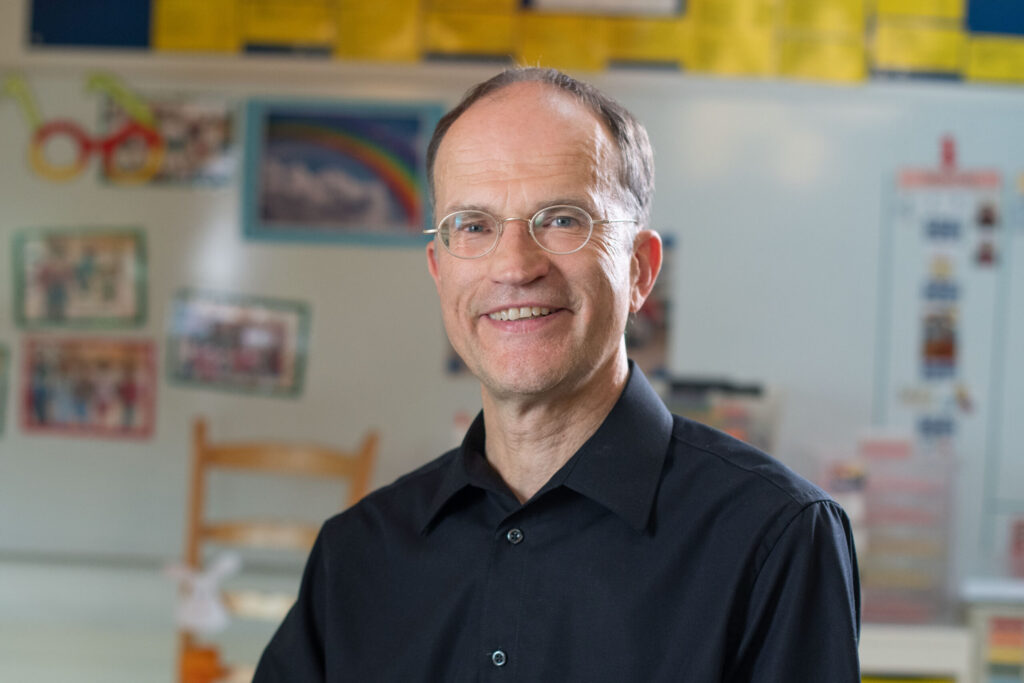
Dietrich von Bonin is a certified arts therapist (ED), specialising in drama and speech therapy, and an SVAKT arts therapist for Anthroposophic Therapeutic Speech. He runs a practice in Bern, is president of the quality assurance committee for the Swiss Advanced Federal Diploma of Higher Education in arts therapy and regularly holds courses and lectures at international seminars. He is also the author of various publications on the subject of arts therapy and speech therapy.
Dietrich von Bonin is the father of three adult daughters and lives near Bern, Switzerland.
Would you like more information about MIS? Interested therapists are welcome to contact us directly. If you as a client have any questions, the certified MIS practitioners will be happy to help you.
Use the many exercise videos to perform MIS exercises yourself or learn them from scratch. Each video includes the relevant verse text and useful guidance on applying the exercise.
Many thanks to Brenda Ratcliffe, Sibylle Eichstaedt, Beatrice Voigt and Helen Lubin for the English translations and improvements.
Get in touch. We will gladly provide you with information on our training opportunities.